Writing can be one of the most rewarding experiences you can have while sitting in one place and working with your mind. It also provides a pure opportunity for self expression, a human need. One thing that any writer will tell you, however, is that it is difficult. There will inevitably be stretches of slowed progress with your writing for one reason or another. You may become stuck at a certain stage of content creation, and unsure of which direction you want to take an idea or how to advance it.
When I was in the midst of generating material for this site, I had an undetracted drive to mine my mind for content. I was always focused on my writing and pushing my creativity throughout the course of my normal work day, even with a power tool in my hand. I had a hard goal to finish multiple blog posts and this forced me to utilize some creativity in the way that I pursued my writing creativity, and I was able to produce positive results thanks to a few of the following ideas.
Block the Time

Productivity blogger and author of the upcoming book Slow Productivity, Cal Newport, claims that planning your day with time blocking can double the amount of things you can get done, or, get your things done in half the time. Time blocking is taking windows of time and dedicating it to nothing but one single goal. First shut down all competing stimuli so you aren’t tempted by the outside world (TV, phone, omegle). In general people underestimate the amount of time that it takes to do something, so I would recommend committing at least an hour to writing if you can afford it. This will deeply submerse you in your thoughts and let you dial in to what you’re doing. Sometimes a solution to a problem may be somewhat counter intuitive, like using a studying-type method in order to conjure up creativity. Nevertheless, committing time to your work is a necessary labor that does the complicated art of writing great justice.
If this is somewhat removed from your comfort zone, be reassured that the quality of your work sessions will gradually get better and better as you fade out mental distractions and delegate your thoughts to refining your work. Soon most of your thoughts will be working for you rather than against you. Plus with daily time blocking you will snap into a habitual desire to write, keeping the process fun and aligned with its purpose.
New Environment
Take a walk to the park or drive to a forest preserve to focus on your creative writing. Break your routine. Taking in this new setting will serve to wipe away the frustrations and residues of previous writing sessions, setting you up with a clear path ahead of you to create. Blogger Jan Fortune wrote an insightful review of her experience writing in new environments with mentors and other writers. She talks about some unexpected benefits like feeling vulnerability while writing, as well as experiencing an altered sense of time and creativity. Settle into a new place, and take notes of the setting. Look at the colors and the sounds of what surrounds you. Note what emotions are aroused in the visitors of the place, and of you specifically. Observe the aspects of your environment and then think about what kind of writing ideas can be derived from it. What kind of stories have started there and ended there?
Commute and Write

One way for me to combine a new environment with time blocking was to think about my writing during another large block of time that I found myself alone, in my daily commuting. Make sure you focus on the road first and your imagination second. Don’t be trying to think of anything too complicated if you are going to zone out and merge into a pond. At a recent job site, the morning drive to work and afternoon drive home along the beautiful and subtly inspiring country roads were almost an hour and a half long each. I spent approximately an hour of that time thinking about my writing goals. What served me well was not only the time spent, but the consistent refreshment of the rolling terrain. It may be worth noting that it always took me a lot of contemplation before I would get into a mind state of flowing creativity (See chart below).
Progress: Documented
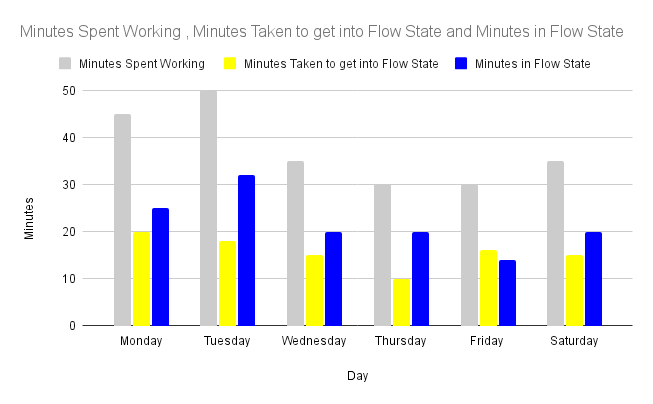
The minutes in flow state were invaluable. They produced multiple new blog topics I decided were perfect to expand on, and homed essential bullet points for the blogs I had already started.
Tap into the world

The world is a massive resource for you to use for your creativity. One common way to feed your writing with the world is to call on inspiration from headlines and world events, allowing you to write about wild scenarios that would sound too fantastical had you made them up outright.
In addition to headlines, scan the world for examples of triumph and tribulation of various levels, thereby opening up your creative mind to examples of drama and conflict resolution that may be under expressed, yet relevant to the human condition, and most importantly, the story you want to tell.
Related Link- Writing Fiction Based on a True Story
This is where the artist in you comes out, because what you do with the world is up to you. Which world event strikes you? What real-world character are you moved by? Your creativity and interests will guide you as you pick out your literary components from the globe that holds all things.
Write a new genre

Trying a new genre could be just the thing to boost your writing creativity. This is the type of writing experiment that deprives you of your comfort zone and pushes your mind to start fresh with a new objective. Putting on a new hat will alter the very way you start off and structure your new piece of work, and give you a brand new opportunity for creative ideas.
Historical Fiction. MAKE HISTORY.
A hybrid writing method exists that blends both fiction and non-fiction in a calculated way. Historical fiction is a way of writing that uses a true-to-life time period, and injects a story of fiction that happens during that time.
Writing stories in historical fiction is immersive because it brings to light the back drop of a part of the world, at certain point in time, gifting you context that may be hard to imagine without personally living in that time. That, along with a meaningful story of fiction from the imagination of someone who appreciates that time period, is a powerful combination.
Which One Resonates ?
Time blocking, attaining a new environment, and connecting your writing with the inspiration of the real world are things that can be impactful for those in a rut, as well as those looking to grow their writing.
Time block your writing at least 3 good times in your next work week. Additionally, try out a new environment for writing as soon as you get the opportunity, and see how it changes your thoughts. Lastly, the next time you scroll through headlines on your phone, pick out at least one topic that you could make part of a fiction, or historical fiction story, and think with it. Document for yourself what you gain from the experiments.


 Mind of Liberty